

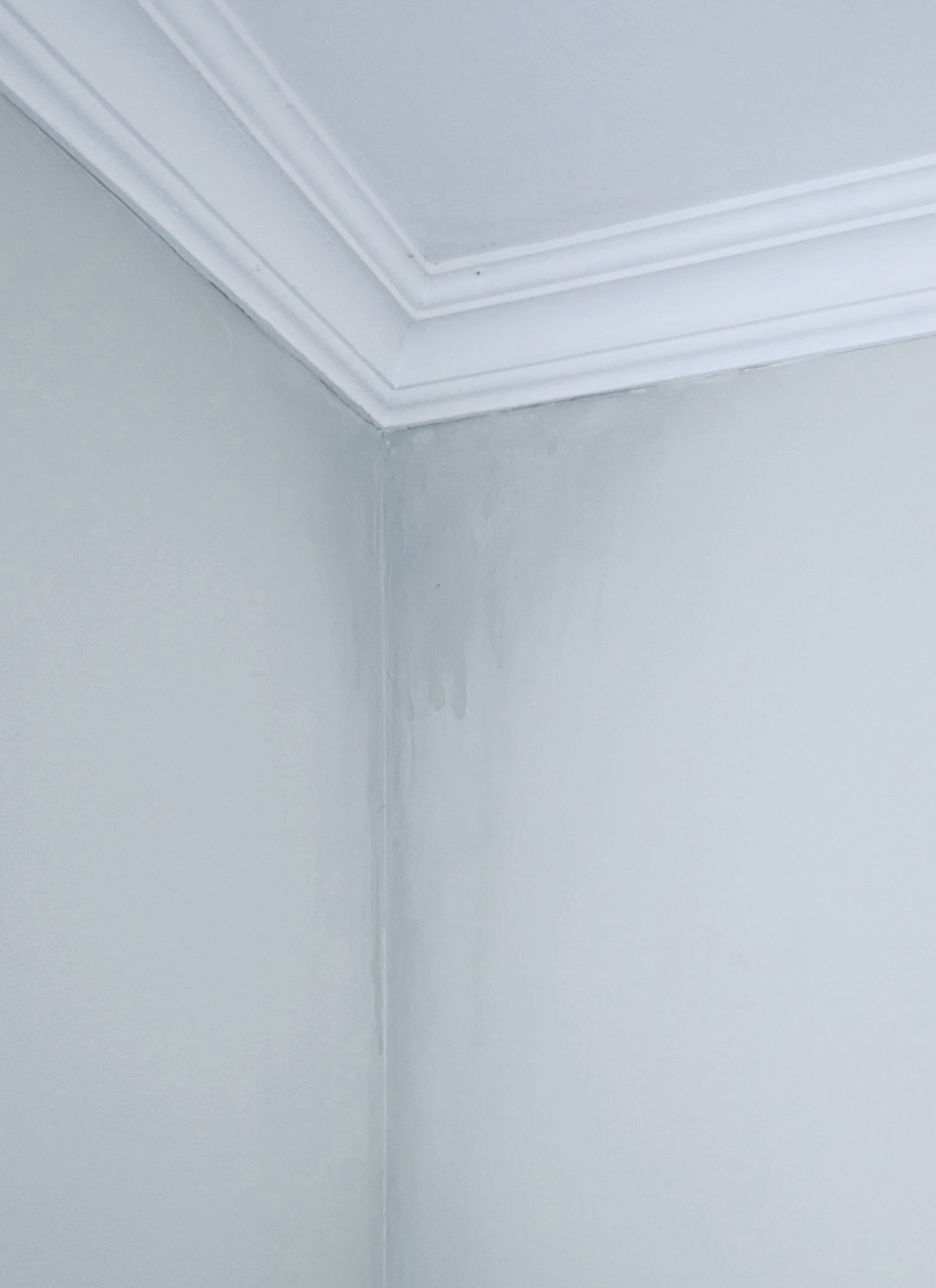
If you keep seeing damp patches or mould returning in the same corners or along ceiling edges, it’s rarely random. This pattern almost always points to a cold surface problem rather than a leak, even though it often gets mistaken for “rising damp” or hidden water ingress.
Understanding why corners and ceilings behave differently to the rest of a room is the key to stopping the problem properly, instead of repeatedly cleaning it and watching it come back. If you want the wider context for where this sits among other common condensation patterns, start at condensation problems in UK homes.
If you’re unsure whether what you’re seeing is condensation or something more serious, it’s worth starting with the condensation diagnosis before assuming structural damp.
What’s actually happening in corners and ceiling edges
Corners and ceiling junctions are the coldest parts of most UK homes. They lose heat faster because they’re exposed on more than one side, and insulation coverage is often weaker or inconsistent in these areas.
When warm, moisture-laden air from daily living rises and moves around a room, it naturally settles against these colder surfaces. Once the surface temperature drops below the dew point, moisture in the air turns into liquid water on the wall or ceiling.
This moisture may not always appear as visible droplets. In many cases it forms as persistent surface dampness that creates the ideal conditions for mould spores to grow.
Why it’s worse in winter and cold weather
The problem usually becomes more noticeable in colder months because the temperature difference between indoor air and external walls increases. Even if the room feels warm overall, corners and ceiling edges can remain several degrees colder.
This is why people often report mould appearing suddenly when winter starts, even though nothing obvious has changed in how the room is used.
Why common fixes often fail
Bleach and mould sprays usually fail because they only treat the surface growth. They don’t change the conditions that allowed the mould to form in the first place.
Opening windows briefly can help in some cases, but it’s often not enough on its own. Ventilation removes moisture from the air, but it doesn’t warm cold surfaces. If the wall or ceiling remains cold, condensation can still form even with fresh air coming in.
Dehumidifiers can reduce airborne moisture, but they’re often used as a substitute for addressing insulation gaps or heating patterns. When switched off, the problem frequently returns.
The least disruptive things to check first
Start by looking at how evenly the room is heated. Corners are more likely to stay cold if radiators are undersized, blocked by furniture, or the heating is switched on and off in short bursts.
Next, check airflow. Furniture pushed tight against external walls restricts warm air movement and traps moisture. Even a small gap can make a difference.
Consistent background heating combined with steady ventilation usually performs better than short periods of high heat followed by long cold spells.
When insulation and building fabric matter
If the same corners or ceiling edges stay damp despite reasonable ventilation and heating, insulation gaps become the likely cause. This is common in older properties, loft eaves, converted rooms, and areas where insulation has been disturbed over time.
Cold bridging at these junctions allows heat to escape quickly, keeping surfaces cold enough for condensation to form repeatedly. A similar “cold surface + trapped air” effect is also common behind large furniture, where the wall can stay damp without being noticed — see mould behind wardrobes and furniture.
Signs it may not just be condensation
Condensation-related mould usually appears on the surface and worsens in colder weather. If you see staining spreading regardless of season, plaster breaking down, or damp that persists even during warm, dry periods, further investigation may be needed.
At that point, ruling out penetrating damp or hidden defects becomes important.
What usually fixes the problem long term
Long-term improvement typically comes from a combination of steadier heating, improved airflow, and addressing insulation weaknesses where possible. Treating mould without changing these conditions almost always leads to repeat growth.
Once the underlying cause is corrected, surface mould can usually be removed permanently rather than managed indefinitely. For the bigger picture of how condensation, mould and damp overlap (and why they’re so often confused), the condensation, mould and damp guide brings it together.